
Why mahjong is quietly becoming the game everyone wants to play again.
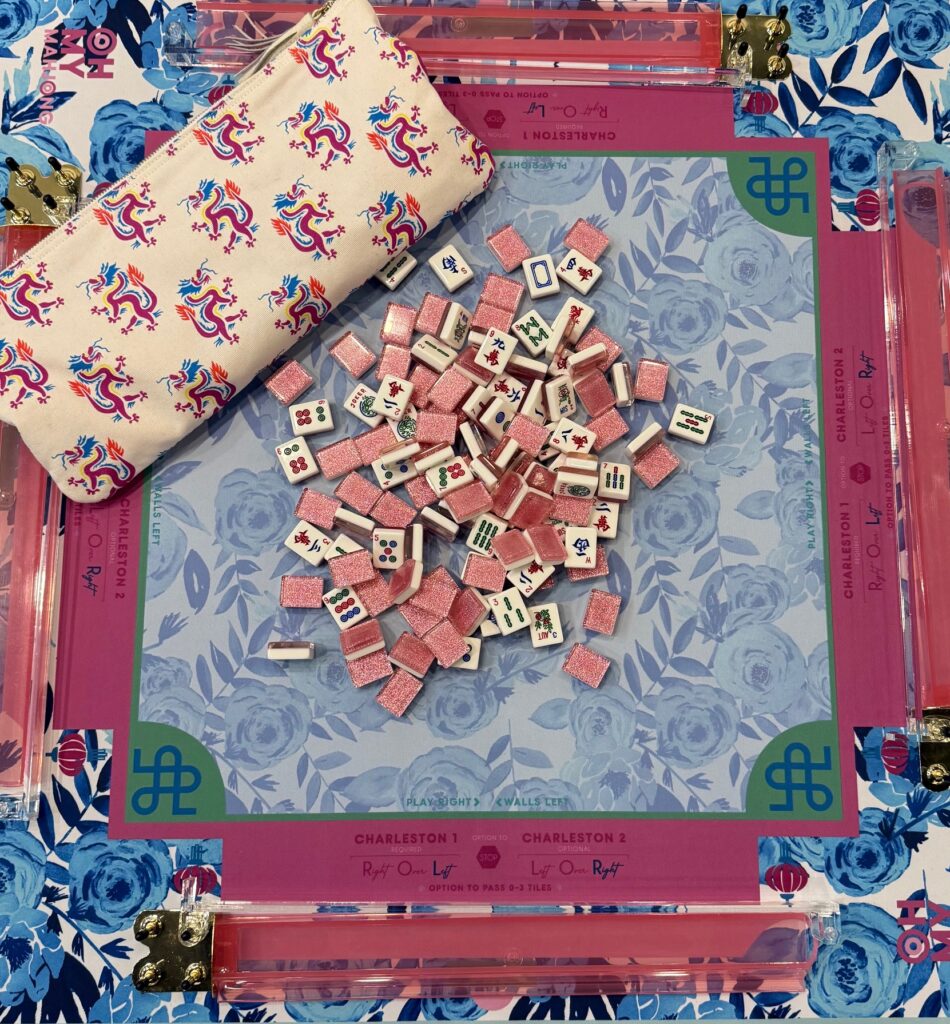
A contemporary mahjong set — where style is as much a part of the game as strategy.
Photo courtesy of Amy Myers
BY REBECCA MEISER
Sarah Emerman didn’t grow up playing mahjong — not exactly.
But the 43-year-old Shaker Heights resident grew up around it.
“My mom plays. My great-grandmother played,” she says.
It was always there, somewhere in the background — a game she associated with older generations, something steady and social, but not quite hers.
So when her sister-in-law, Julie Gurney, suggested learning a couple of years ago, it felt less like picking up something new and more like stepping into something familiar.
She and Julie, along with some other friends, learned together, gathered around a table while Julie’s mother-in-law, Enid Gurney, a longtime player, walked them through it, correcting, explaining and repeating.
“She would just sort of tell us everything we were doing right and everything we were doing wrong,” Emerman says, laughing.
At first, it felt impossible.
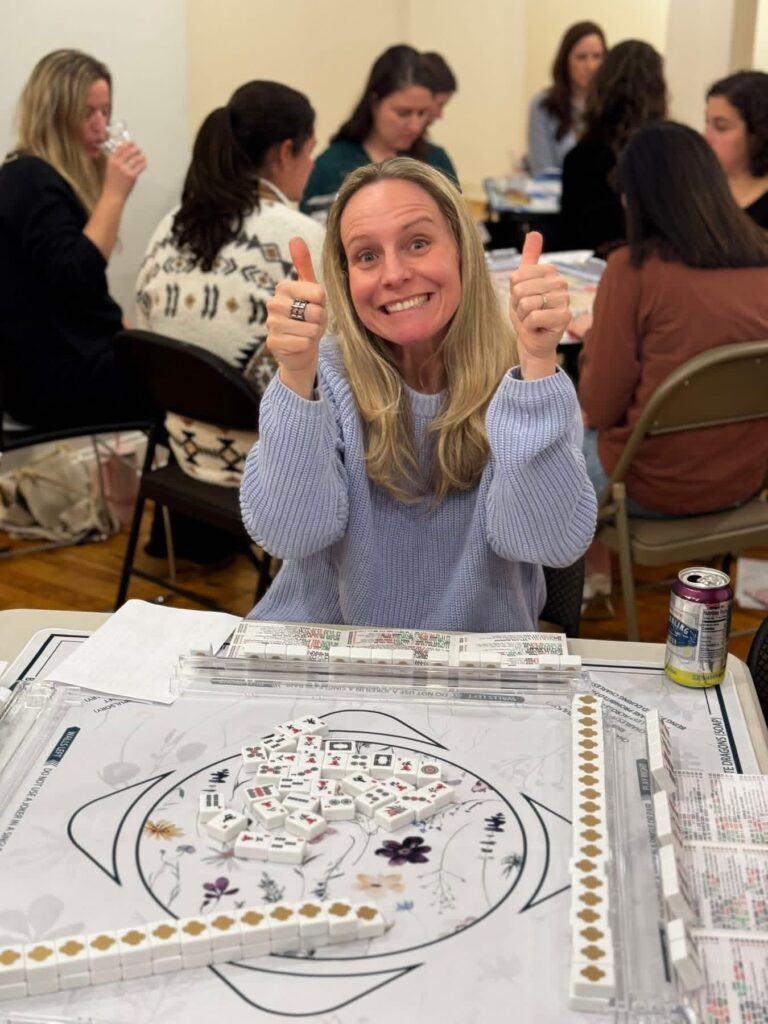
Shaker Heights mom Becky Rocker plays mahjong at an event at Sha’ran Studios, part of a growing wave of players rediscovering the game’s social pull.
Photo courtesy of Sarah Emerman
“I remember thinking, how am I ever going to keep all this straight?”
The tiles blurred together. The rules piled up. The rhythm didn’t quite stick — until, suddenly, it did.
What Emerman stumbled into is now happening everywhere.
Mahjong, the centuries-old Chinese tile game that later became a cornerstone of Jewish social life in the United States, is having a moment again.
At its simplest, four players sit around a table, building hands from a shared set of tiles marked with symbols — bamboo, circles and characters — drawing and discarding until someone completes a winning combination.
It is often compared to rummy, but it’s more layered: part strategy, part memory, part instinct. Once it clicks, people tend to come back to it again and again.
That pull is part of what’s driving the resurgence, but it’s not the whole story.
After years of screens, isolation and over-scheduled lives, people are gravitating toward anything that brings them back into shared space, around a table, in real time.
It’s part of a broader return to analog life: things you can touch, share and experience together. Mahjong fits naturally into that.
“It’s almost a level up from grabbing coffee or lunch with friends,” Emerman says, adding: “I like to play at least once a week. I hate it when it’s less.”
For many players, that consistency quickly grows into something bigger.
“I’m in several text threads,” says Abby Botnick, a 46-year-old Shaker Heights attorney, describing a steady stream of messages organizing games, filling tables and pulling people in.
“The group chat keeps growing,” she says. “You keep adding people, and then you have to reintroduce who we are.”
There’s almost always a game happening somewhere.
And when people do get together, it doesn’t feel like anything else.
“You’re not doing that at a bar,” she says — the yelling, the teasing, the mock accusations when someone breaks a rule.
“It’s just a different vibe.”
It’s social but focused, competitive, but forgiving.
“I feel like I’m doing something good for my brain while also socializing,” Botnick says.
The game itself isn’t new, but the way people are finding their way to it is.
Mahjong arrived in the United States in the 1920s and quickly became embedded in Jewish social life, particularly among women who gathered weekly to play. The National Mah Jongg League, founded in 1937, helped standardize the American version still widely used today.
For generations, it was passed down informally, learned by watching, sitting in and eventually taking a seat at the table.
“It almost feels like a cultural connection,” Emerman says.
What’s different now is how far that circle has expanded.
Celebrities like Julia Roberts and Meghan Markle have embraced the game. Blake Lively has even been known to travel with her mahjong set. Closer to home, it’s showing up across Cleveland (Even at the Cleveland Jewish News, sister publication to Jstyle. Check out our Mahj and More event on Thursday, May 7th at StoneWater Golf Club at cjn.org/mahjong).
“There’s all these pockets of people around Cleveland that are playing,” Emerman says.
High school friends. Book clubs. Neighborhood groups.
Even, occasionally, spouses.
“I won’t teach my husband,” Emerman says, laughing. “Then he’d want to come and there would be no one to watch the kids.”
Some things, it seems, are better kept to the group.
For Amy Myers, that growing interest became something she couldn’t ignore.
She first learned to play in 2007, as a young mom looking for a reason to get out of the house.
“It was my excuse to get out every week,” she says. “It was a way to just kind of reconnect with my girlfriends.”
Years later, after buying a bag for her tiles, she started noticing something familiar — but slightly different — taking shape again on social media.
“This is what people are doing,” she says. “We’re having lunches again. We’re having game nights again. And the tiles are really pretty.”
Around the same time, she was entering a new phase of life, becoming an empty nester and starting to think about what came next.
“I love being with people,” she says. “I thought, I could totally do this.”
She started small, going house to house, teaching whoever could gather. Almost immediately, the game began to outgrow those living rooms.
“It’s not something you can just learn once,” she says. “You have to keep playing to feel comfortable.”
Her students felt it too.
“They say, ‘I love this so much, but now what? Where do we play?’”
Some groups couldn’t coordinate schedules; others simply didn’t have enough players.
“I just saw this huge demand,” she says. “People want to keep going.”
Eventually, the momentum made the decision for her.
“I took a leap,” she says. “It’s like mahjong. If you don’t go for the line, you’re never going to win it.”
In January, she opened The Mahjong Maison at Eton Chagrin Boulevard, a 1,300-square-foot studio built entirely around the game.
Now, instead of squeezing into living rooms, players have a place of their own.
Lessons, leagues and open play fill the schedule, and on some nights, dozens of people cycle through.
“We’re all looking for somewhere to go,” Myers says. “And we want it to feel good when we get there.”
Nationally, the trend is catching up to what players are already experiencing.
Yelp named mahjong one of the top trends of 2026, citing a 4,467% jump in searches for clubs and an 819% increase in lessons.
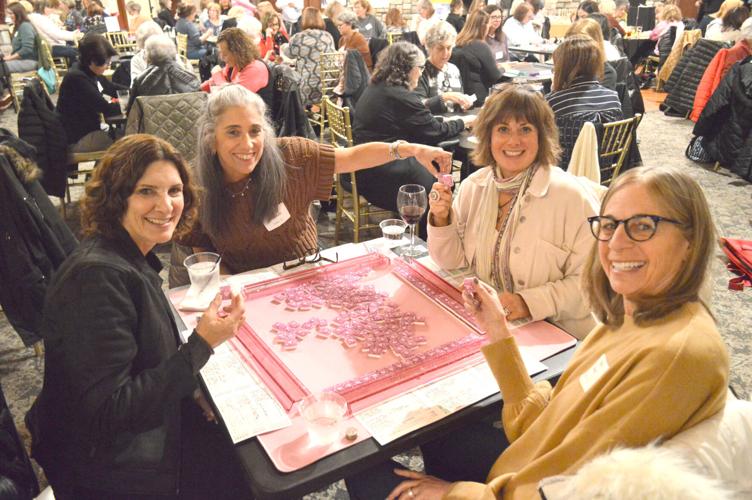
Amy Small, Julie Millman, Cheryl Scharf and Marcy Silver at the CJN’s 2025 Mahj & More event —
part of a broader return to analog life, where people gather to touch, share and experience together.
CJN photo courtesy of Jimmy Oswald
New sets, new spaces and a new wave of players.
But at its core, the appeal hasn’t changed.
It’s still four people around a table — a game that rewards time and attention, and gives people a reason to gather and come back.
“We used to go out and do cool stuff,” Emerman says, laughing. “Now we just sit and play.”
And lately, that feels like enough.