
BY REBECCA MEISER
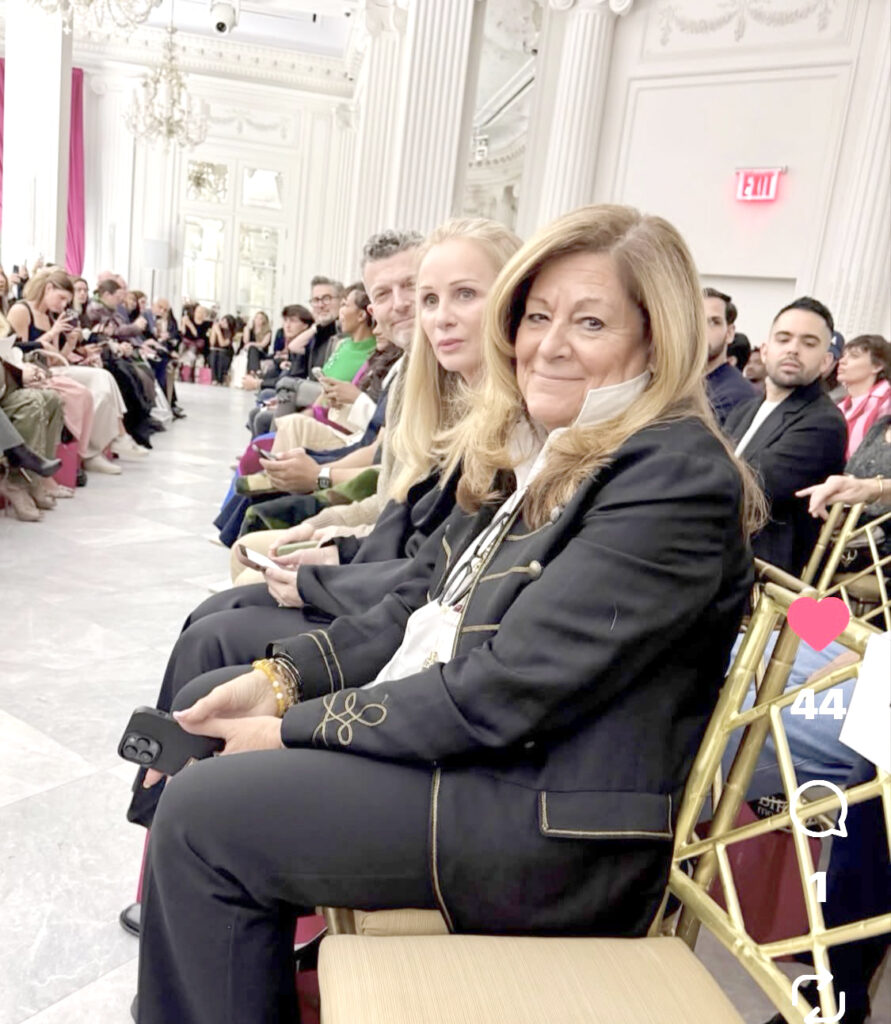
Fern Mallis — known as the Godmother of Fashion Week — at a runway show.
Photo courtesy of Fern Mallis
Before New York Fashion Week became what it is today — centralized, structured and global — it was something else entirely: disjointed, scattered and at times even unsafe.
Fern Mallis, known as the Godmother of Fashion Week, can still point to the moment that made that clear. In the early 1990s, just before stepping into her role at the Council of Fashion Designers of America (CFDA), the industry’s leading trade organization, she had been hired to help organize programming, events and communications for its growing membership of American designers.
Then came a Michael Kors show in a Chelsea loft.
The music was loud enough to shake the room. Then the ceiling started to crack.
“Plaster started to come down onto the runway — onto Cindy and Linda and Naomi — and they just kind of brushed it off their shoulders and kept walking.”
In the front row, editors weren’t watching the clothes.
“They wrote that ‘We live for fashion. We don’t want to die for it.’ I don’t know if anyone remembered what Michael showed. People were looking for where the exits were.”
She hadn’t even officially started the job.
“I said, ‘I think my job description just changed.’”
Instead of simply supporting designers, Mallis saw something bigger: a need to bring order, safety and structure to an industry that had none — a shift that would ultimately lead to the creation of modern New York Fashion Week.
What kind of kid were you growing up? What drew you in before fashion was even part of the picture?
I was a good girl. I grew up in Brooklyn, before it became artisanal. I was a middle child and had a bunch of friends on my street.
I went to work with my dad all the time, on days off from school or holidays. He worked in the garment center, and his two brothers did as well. We would go and meet him, and I’d go to lunch with him and his buyers, the fashion directors of the stores he worked with.
What did fashion mean to you then?
I don’t know that it meant anything specific. I just always liked it. I loved dressing up.
My mother had great clothes, really interesting clothes. I could kick myself that we don’t still have them. Beautiful pleated pants and jackets, very Katharine Hepburn–ish.
She had a skirt with a shawl that had all these bold patterns of color. I can still picture it perfectly.
And because of my dad, I had a million scarves growing up. I always knew how to tie them and make things out of them. One uncle was in sportswear, so I got clothes from him. Another was in textiles, so I got fabric and would make pillows or cover things.
So my fashion sense was really just growing up around that.
How did Judaism show up in your life growing up?
We weren’t a very religious family. My mother was Sephardic, my father Ashkenazi, and we identified more with my mother’s side. It was more interesting, and the food was better.
We didn’t have bat mitzvahs. There were no boys, and my father didn’t feel the need to join a synagogue.
But there was a synagogue right behind our house, across the backyards. For a period in my early teens, I really wanted to go to Friday night services. My parents weren’t quite sure what to do with me, but I loved it.
Life goes on, you get busy, but I’ve always proudly identified as Jewish.
You didn’t start out as a designer. When did you realize your role was more about organizing and connecting?
My career started at Mademoiselle magazine. I was a guest editor and stayed for six years. Then I became fashion director at Gimbels East and eventually opened my own public relations firm.
I started with fashion clients, and then it segued into interior design and architecture, which I’ve always loved. I never understood how someone could live in a horrible space and dress beautifully, or vice versa. To me, it’s all connected.
At the International Design Center in Long Island City, my job was to bring together architects, designers and manufacturers. I just did what needed to be done. It was common sense — the kinds of events and activities that would generate interest and bring people together.
I loved all of it.
That’s what led me to the CFDA, the Council of Fashion Designers of America, where I would go on to help organize what became New York Fashion Week. I thought, if I can organize architects, who have very big egos tied to their buildings, I can deal with fashion designers.
Before New York Fashion Week became what it is today, what did you see that wasn’t working?
If there were 50 shows, there were 50 locations. Nobody talked to each other.
And if you didn’t know and weren’t invited, you really didn’t know it was Fashion Week. You might think there was a sample sale on Seventh Avenue because there was a line outside.
That Michael Kors show was right before I moved into the office, and I thought this is something the CFDA should address. These designers were all CFDA members.
That became the mission: to organize, centralize and modernize the runway shows.
Being inducted into Kent State’s Fashion Hall of Fame, what does that recognition mean to you now?
It’s really lovely when people call or email and say, we want to honor you. When they tell you your name came up and it was unanimous, it feels wonderful.
I’m not as much in the thick of things as I once was. I’m not out there every day making things happen in the same way.
I still get emails and DMs — designers saying, I’ve got this collection, can I have some of your time. I just can’t respond to all of them.
But sometimes interesting things come your way. There was a woman who came to my office who is starting an e-commerce business working with clothing for people with disabilities — making buttonholes bigger, elastic waists, things that are easier to manage. It was lovely hearing what she was doing. I gave her some contacts and emails that I don’t generally give out.
And I spend time mentoring Max Alexander (the 10-year-old designer who made history in March 2026 as the youngest to show a collection at Paris Fashion Week). His mom just sent me a picture of him at the Seder table. I love doing that.
For students graduating now, what matters most — and what do people get wrong?
Sometimes people think they’re ready to start their own business. Slow down. That’s when you have to earn your stripes.
You have to knock on a lot of doors and send a lot of emails.
If you want to be a designer, work in retail. Be in a store. Watch how it works. At the end of the day, you want someone to walk in, take out their credit card and buy something you made.
And travel. See the world. Absorb what’s going on. Go to museums, go to the theater. Not through your phone, in real life. Taste the food, smell the air. Those things stay with you.
You’ve worked with so many iconic figures. Do you see any common traits among those who succeed?
One thing that comes up again and again is how many people cite their grandmother as their biggest influence. At first I thought it was a coincidence, but it became a pattern.
So many designers were raised by their grandmothers or inspired by them. It’s remarkable how often it comes up.
What was your grandmother like?
Not one of those. My father’s mother was an older Romanian woman, and she didn’t have much influence on my life.
I do wish I had some of her recipes.
How has the industry changed the most?
The internet and the iPhone changed everything. People don’t even sit at a fashion show without holding up their phones. They’re watching it through a screen.
E-commerce has completely changed how people shop. You can have a business now without ever being in a store.
And now AI is beginning to change things as well.
With everyone having a platform, what makes a brand stand out?
Authenticity. Originality. Creativity. The same things that have always mattered — they just matter more now.
When you think about your career, what do you hope people say about you?
That I was nice.
Lightning Round
One word to describe fashion right now:
Complicated
Most underrated job:
The factories, the people making things
A trend you wish would disappear:
Naked dressing. Chiffon over a bodysuit is not a dress
A designer who always gets it right:
Michael Kors
Your go-to outfit:
A Lafayette 148 sweater set
Best career advice:
Hang in there
Scan to read more about Kent State University Fashion Hall of Fame inductee Fern Mallis.
read more about Kent State University Fashion Hall of Fame inductee Fern Mallis.